A steady Tuesday in our online alternative provision
This morning the BBC published an investigation into school closures in England — and found that children with special educational needs (SEN) are being hit hardest. Of around 120 state-funded schools that closed between 2020 and 2025, roughly 29% of pupils had an education, health and care plan or other SEN support, against a national average of about 20%. More than 2,000 children with SEN were on the rolls of schools that went on to shut. NEO is an online alternative provision built for exactly these young people — and this post is about what a steady day inside it actually looks like.
The numbers matter. But the part that stays with you is the human one. The report describes children for whom the loss of a familiar building, a familiar routine and the adults who finally understood them isn’t a logistical inconvenience — it’s a rupture. Broken sleep. Heightened anxiety. A new school that never quite becomes theirs. For a young person who is autistic, has ADHD, or has lived through EBSNA (emotionally based school non-attendance), what was working was usually the predictability and the relationships. A closure takes away exactly those things.
Why we built our online alternative provision this way
The pressure that closed those schools — a building in one neighbourhood, a roll that can no longer cover the cost of the site — isn’t the pressure we’re built on. And the things those children lost — a steady routine, one consistent adult, a setting that understands them — are the things we have designed the whole day around.
So this post is for the parents and carers who come to our open events and ask the same question in slightly different ways. What does a day actually look like? What will my child be doing at 11am on a Tuesday? Who will they be talking to? What if they’re having a bad morning? First, the shape of a whole week.
A typical week
This is the indicative week we show parents and carers at our open events. Across the top, Monday to Friday. Down the side, the teaching slots, with breaks built in between each one.
| Time | Mon | Tue | Wed | Thu | Fri |
|---|---|---|---|---|---|
| 9.30–10.15 | English Language | Mathematics | Human Biology | Art & Design | Relational Intelligence |
| 10.30–11.15 | English Literature | Mathematics | Human Biology | Art & Design | Digital Skills |
| 11.30–12.15 | English Language | English Literature | Mathematics | Mathematics | RSHE |
| 12.30–13.15 | Practitioner check-in | Practitioner check-in | Practitioner check-in | Practitioner check-in | SDG / Creative |
It’s indicative — not every learner takes every subject. The timetable adapts to each learner’s pathway and what they’re ready for. Monday to Thursday is structured academic learning, taught by qualified subject specialists. Friday is Cornerstones Day, which we’ll come back to.
And notice the last row. A practitioner check-in built into the end of every single day. That isn’t a nice extra we fit in when there’s time — it’s part of the architecture. One consistent adult, every day, who knows your child.
A Tuesday, hour by hour
Let’s zoom into one day. Here’s a Tuesday in the autumn term.
Just before 9.30 — Morning welcome. The Student Success Coordinator opens the morning with a short Google Meet for the cohort. It isn’t a lesson and it isn’t compulsory. It’s a way to start the day with a familiar face — to check who’s around, what’s coming up, and whether anyone needs a hand finding their first link.
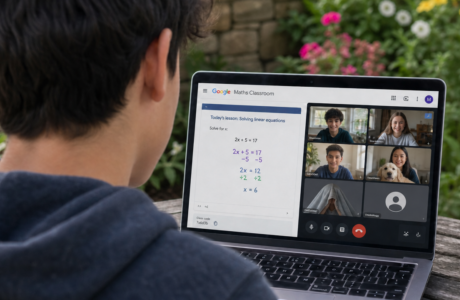
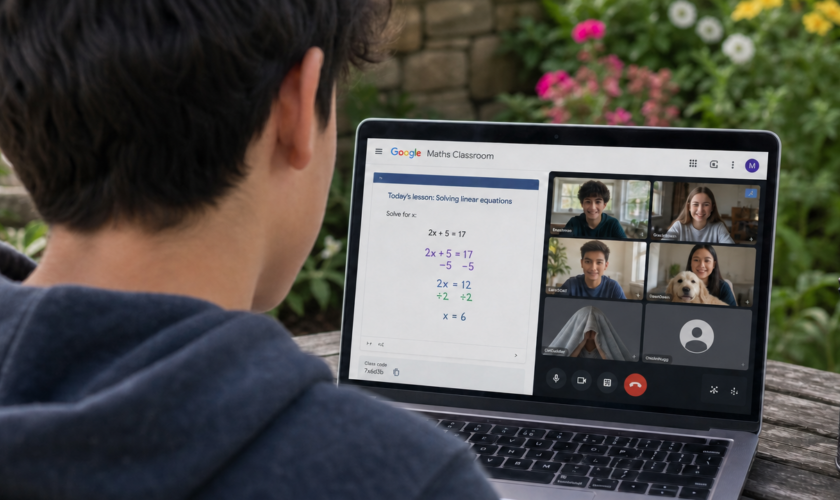
9.30 — First lesson: Mathematics. The teacher is a qualified subject specialist; the lesson is on Google Meet. Cameras are optional. Your child can have theirs on, off, or somewhere in between. They don’t need to ask permission for that, and no-one is going to ask them to turn it on “just for the register”. The register is taken from the platform, not from faces.
10.15 — Short break. Fifteen minutes off-screen. We’re explicit about this. If your child wants to make a cup of tea, lie down for ten minutes, or step into the garden, that’s part of the day — not a sign they’re struggling.
10.30 — Second lesson: Mathematics. Same shape — qualified teacher, small group, the named practitioner sometimes sitting in as a familiar face, but never as the teacher.
11.15 — Break.
11.30 — Third lesson: English Literature. A qualified English teacher, a small group of learners, practitioner-led pastoral support alongside the teaching — never replacing it.
12.15 — Break.
12.30 — Practitioner check-in. The day’s teaching closes with twenty minutes that belong to your child and their named practitioner. The practitioner has known them since their first day at NEO. They’ve talked about the difficult Tuesday last term when nothing went to plan, and the breakthrough on a piece of writing the week after. Part conversation, part planning, part “how did today land for you?”. Some days nothing big happens, and that’s fine. Consistency is the point — and it happens every day, not once a term.
After 13.15 — A real lunch, then quieter work. Lunch is a proper break, away from the screen — we are not interested in a model that has learners eating in front of a lesson. The afternoon is lighter: independent, self-paced work in Google Classroom, set to each learner’s pathway, with the practitioner reachable by message if your child gets stuck. The day stays deliberately bounded.
That’s the rhythm. Three live lessons taught by qualified specialists, structured breaks, a daily practitioner check-in, and a recognised adult at the start and the close. It is deliberately small, deliberately predictable, and deliberately bounded — the day finishes when the day finishes.
The questions parents always ask
The camera question. Cameras are optional in every live session. Not “in some”. Not “after a settling-in period”. Optional means optional. Your child doesn’t owe anyone their face to be allowed to learn. If they want to use a still image, a coloured square, an avatar — that’s fine. The teachers know who they are.
“What if they’re having a bad morning?” Send a message — to the practitioner, to the platform — and we’ll know. We don’t withdraw the lessons from view; we work out together whether today is a “join for one” day, a “set work, take a rest” day, or a “let’s talk first” day. We absolutely do not pretend the bad morning isn’t happening.
“Is anyone really watching?” Yes. Attendance, engagement, and a session-level safeguarding log are updated after every session — not at the end of term. You can see what your child has been part of this week. So can their commissioner, if they have one. The same facts, appropriately framed for each audience.
The Friday question. Friday is Cornerstones Day — Relational Intelligence, Digital Skills, RSHE, Sustainable Development Goals projects, creative work. We’ll do a whole post on Friday later in this series. The short version: the week needs a different kind of day in it, and Friday is where that lives.
See a Tuesday for yourself
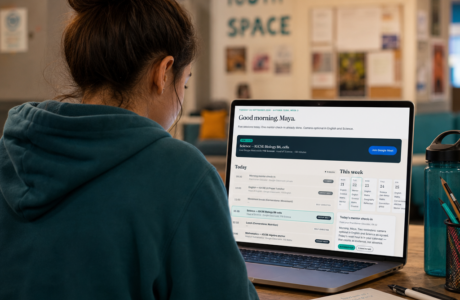
If you want to see a Tuesday for yourself, our open day demo is online. Choose “Enter as a learner” and you’ll see exactly the timetable, platform and mentor view described above. It uses fictional names; the architecture is real.
A school can be taken away from a child. The routine, the relationships and the steadiness underneath them don’t have to be.
More articles
Go to the blog