How NEO is designing a bespoke maths curriculum with AI

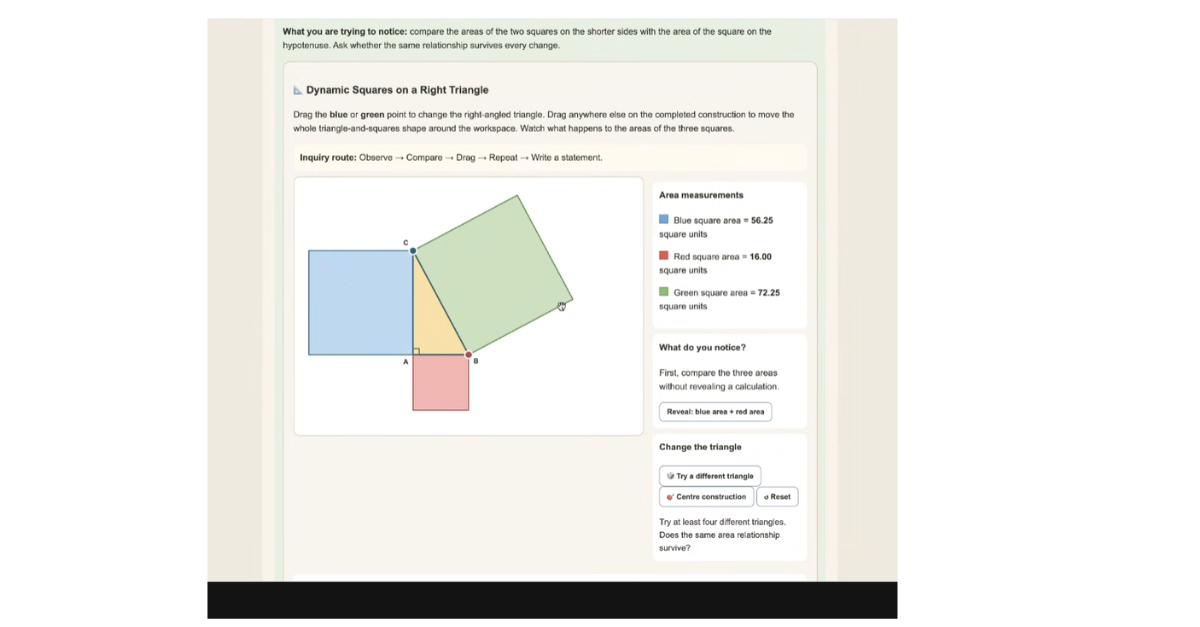
Open one of the maths lessons currently being built for Nudge Education Online (NEO) and the first thing you meet is not a formula. It is a driving question — what relationship survives when the triangle changes? — and an interactive diagram: a right-angled triangle with a square drawn on each of its three sides. Drag a corner and the areas recalculate in front of you. Blue plus red keeps equalling green, whatever you do to the triangle. You have discovered Pythagoras’ theorem before anyone has shown you the formula — and you are inside NEO’s bespoke maths curriculum.
That lesson is one of several hundred taking shape for NEO’s first intake this September, and the way we are building them says a lot about what we think a bespoke curriculum — and artificial intelligence in education — should actually mean.
Reverse-engineering a bespoke maths curriculum
Most of the sector’s AI energy is currently going into chatbots: a tutor-shaped text box that answers questions on demand. We are doing something closer to the opposite. A highly experienced maths educator designs the pedagogy — the driving question, the sequence of ideas, the common misconceptions, the moments where a learner is likely to wobble — and uses AI as the workshop that builds it: the interactive diagrams, the drag-and-drop formula tiles, the guidance panels, the practice questions with their hints and Socratic prompts. The intelligence shaping every lesson is human. The AI is how one educator’s judgement becomes a fully interactive, differentiated, scaffolded curriculum rather than a pile of worksheets.
That distinction matters. A chatbot personalises the conversation. A reverse-engineered curriculum personalises the learning itself — the pathway, the pace, the scaffolding — while keeping a consistent, carefully designed structure underneath.
The Six Cornerstones, inside every lesson
NEO’s pedagogy rests on the Six Cornerstones — Connection, Movement, Creativity, Reflection, Rest and Nutrition — and in the maths curriculum they are not a wellbeing layer bolted on around the edges. They are the anatomy of each 45-minute lesson.
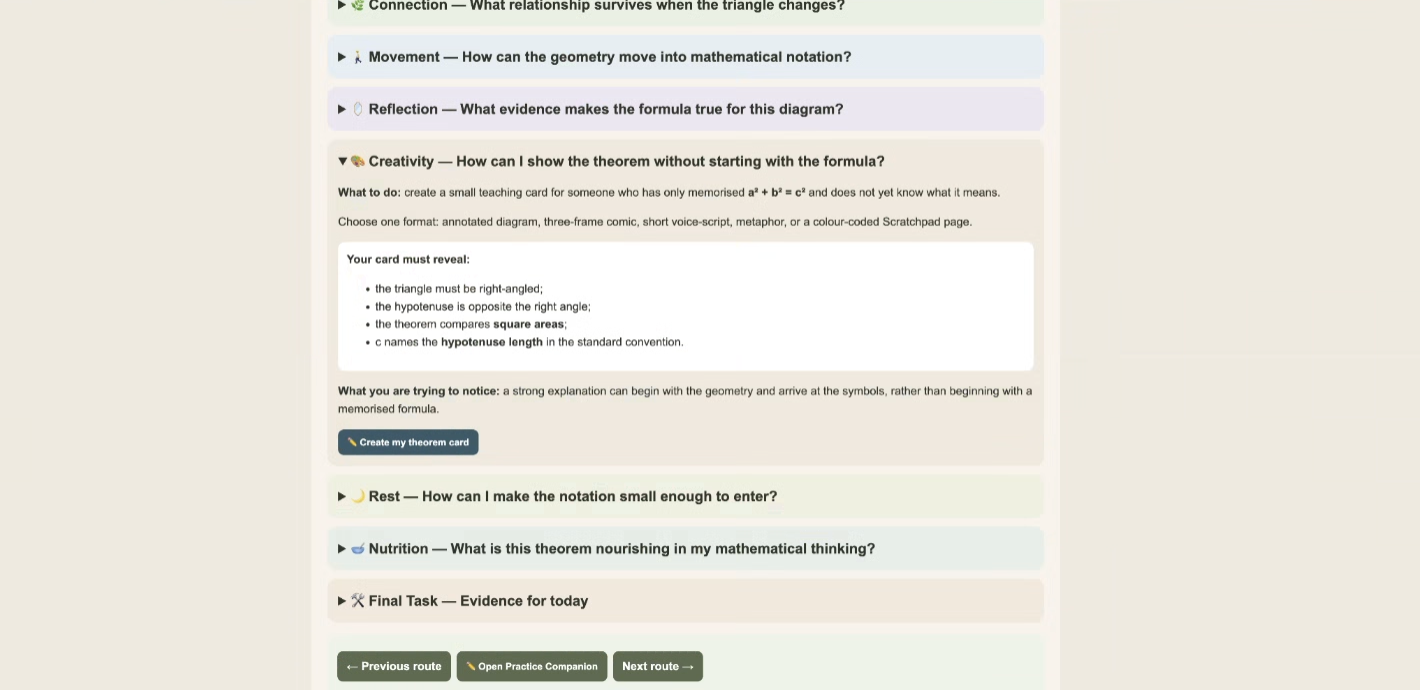
In the Pythagoras lesson, Connection is the exploratory panel above: notice the relationship, test it, record a conjecture. Movement carries the learner from geometry into mathematical notation — labelling sides, naming areas, building the formula physically from shuffled tiles. Reflection asks them to read a diagram in order and complete the statement in their own words. Creativity invites them to teach the theorem without starting from the formula, designing their own teaching card. Rest is explicit permission to pause: you do not need the whole diagram and formula in your head at once — find one connection at a time, and stop after any step.
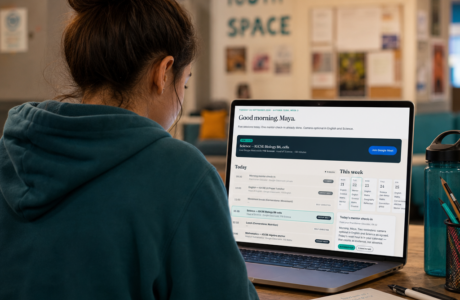
Alongside the panels sits a practice companion — questions with a Socratic prompt and a hint each, and worked solutions that open once you have had an honest try — and a built-in maths scratch pad: a whiteboard with pens, sticky notes and adaptive backgrounds (a ratio table instead of a square grid, when that is what the lesson needs), where anything you make can be saved as an image for your portfolio.
All learning is nourishment
Nutrition is the Cornerstone people expect us to force, so we decided not to. Where a lesson has a natural mathematical context — the proportions in a smoothie recipe, say — Nutrition appears in that literal sense. Where it does not, we refuse to bolt it on artificially. Instead, the lesson asks a different question: what is this theorem nourishing in my mathematical thinking? All genuine learning is nourishment — intellectual nourishment — and treating it that way keeps the Cornerstone present without ever making it feel contrived.
The literal kind still gets its gentle nudges, too: finding this difficult? Leave your screen, have a drink and something to eat, come back — and notice how your thinking has changed.
Bridge lessons, not gaps
Learners arrive at NEO with jagged profiles: strong in one topic, missing two years of another. So each topic is built from core lessons plus bridge lessons — optional lessons that reach back to earlier material a learner probably met but may not securely hold. Nothing is compulsory; the curriculum offers suggested pathways rather than a single track. If you need the bridge, you take it. If you do not, you walk straight past it. That is what bespoke means in practice: the same rich curriculum, a different path through it for every learner.
Levels, not labels
A 17-year-old rebuilding their relationship with maths should never have to say “I’m doing Year 9 maths”. So lessons are tagged by level — elementary, intermediate, advanced — with the formal mapping kept underneath: which lessons are pre-International GCSE, and how the intermediate level aligns to the Pearson Edexcel International GCSE in Mathematics. Schools, commissioners and awarding bodies can sort the curriculum the way they need to; a learner only ever sees a level, never a label that shrinks their sense of self. The same architecture means an adult returner could one day work through the elementary curriculum asynchronously, with no year group in sight.
Built for every adult helping a child
Every lesson carries two layers of guidance. A learner guide, for young people working asynchronously: your stepping stones, what to do when you feel stuck, how to know you are making progress, and the final portfolio piece. And a supporting-adult guide: common misconceptions, supportive prompts, how to get the most from the interactives.
At NEO, qualified subject-specialist teachers deliver the live lessons, and this asynchronous curriculum sits alongside their teaching. But the design deliberately reaches further. Nudge practitioners mentor young people in alternative provision across the UK, and a curriculum built this way lets a practitioner and a young person design a smoothie together, work through the ratios, and evidence real mathematical learning — without the practitioner ever needing to be a maths teacher.
The first lessons are taking shape now, ahead of September’s Year 9 and Year 10 intake. You can watch the curriculum grow at the NEO curriculum vault.
More articles
Go to the blog