Connection before curriculum: the Six Cornerstones
Anyone who has ever sat opposite a young person whose nervous system was somewhere else knows what it’s like to try to teach them. You can have the lesson plan. You can have the resources. You can be well-trained and well-meaning. None of it lands until the young person can be in the room.
For most of our careers in the sector, the official advice was a sequence: stabilise the wellbeing first, then start the learning. Reasonable enough. It does, however, leave you with an awkward question: who is doing the stabilising, with what, for how long, and what counts as “ready”?
The truth from the practice is that the sequence isn’t a sequence. The young people who do best in our care are the ones for whom wellbeing and learning happen as the same activity, in the same hour, with the same trusted adult nearby.
The Six Cornerstones are how we’ve named that pattern. They have been the implicit shape of Nudge Education’s practice for years. We’ve made them explicit at Nudge Education Online (NEO) so we can design for them, train for them, and explain them.
The Six Cornerstones
- Connection — relationship, belonging, community. The first cornerstone, always.
- Movement — physical activity, embodiment, the body in the learning.
- Creativity — expression, innovation, exploration.
- Reflection — metacognition, self-awareness, growth.
- Rest — regulation, recovery, pacing.
- Nutrition — fuel for learning, healthy habits.
These aren’t a values list. They are design constraints. When we build a session, a timetable or a programme, we ask: which Cornerstones are present in this hour, in this week, in this term?
Some examples of what that means in practice at NEO.
How the Cornerstones shape the week
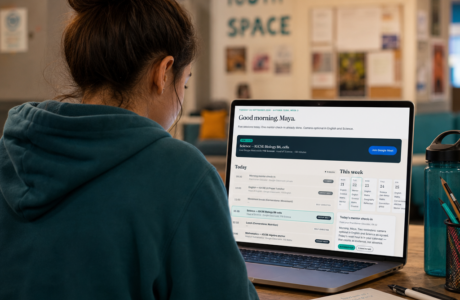
Connection is the reason every learner has a named practitioner — a single mentor who stays with them through every change of subject and every transition. It is the reason the day starts with a morning welcome from the Student Success Coordinator, not a register. It is the reason cohorts are deliberately small and the camera is deliberately optional — connection has to be voluntary to be real.
Movement is the reason live sessions are 45 minutes, not 60, with structured breaks. It is the reason the timetable has a real lunch hour rather than a notional one. We don’t pretend an online school can replicate a school field. We do make sure no learner is asked to be still and screen-facing for hours at a stretch.
Creativity runs through Friday’s Cornerstones Day, where SDG projects, creative work and Digital Skills sit alongside Relational Intelligence and RSHE. It also runs through how we approach Pearson Edexcel International GCSE coursework — modular, drafted, redrafted, brought back to a trusted adult before it’s submitted.
Reflection is built into the platform. Every mentor check-in has a structured reflection layer; every Friday closes with a short personal note. The mycelial portfolio (a different post for a different fortnight) is the long-form record of how that reflection grows over a term.
Rest is the cornerstone most likely to be quietly dropped from a school timetable. We’ve designed against that. The breaks in the day are real and visible to the learner, the family, and the commissioner. A learner who is asleep at 11am after a bad night is not failing; they are following the architecture we built for them.
Nutrition lives in the family conversation more than the school day, but it is in our pastoral remit. The Student Success Coordinator’s morning check-ins include practical questions about breakfast and water. Our Cornerstones Day curriculum includes nutrition as a content area, not a footnote — and as our recent piece on the bespoke maths curriculum showed, it now lives inside every lesson too, sometimes as mathematical context, always as intellectual nourishment.
Why this matters beyond NEO
The reason all of this matters for the sector — beyond NEO’s own practice — is that the field is full of frameworks that promise wellbeing and learning together, and most of them are actually wellbeing and then learning, with the timing slightly tightened. The Cornerstones are an attempt to name what the together looks like, in detail enough to design for.
We are not the only people doing this kind of work. We learn a great deal from colleagues in trauma-informed practice, attachment-based education, and youth work. The Cornerstones aren’t claiming originality; they’re claiming a useful name for a pattern that already exists and isn’t always given one.
For practitioners, the practical value is this: when you can name what you’re designing for, you can tell when it’s missing. A session that doesn’t include Movement isn’t a worse session because it broke a rule; it’s a session that should have had a break in it. A learner whose Reflection cornerstone is absent isn’t being uncooperative; they’re being asked to grow without a structured mirror.
If you’d like to see how the Cornerstones show up in a real day, our open day demo walks through a Tuesday at NEO from a learner’s view, a practitioner’s view, and a commissioner’s view — all three are designed against the Cornerstones, in different surfaces.
More articles
Go to the blog